

Failure is rarely a permanent destination; instead, it serves as a volatile forge where true character is shaped. When plans dissolve into chaos and expectations crumble, the initial instinct is often despair. Yet, human history is defined not by those who never stumbled, but by those who mastered the art of rising after every fall. Internalizing profound quotes on resilience alters cognitive framing, shifting perspective from acute defeat to long-term mastery. By engaging deeply with these timeless words, we rewire our emotional responses, build psychological agility, and cultivate a quiet, unshakeable mental fortitude that outlasts any temporary setback.
- Embrace Setbacks as Data: Shift your cognitive framework to view failure not as a moral indictment, but as objective feedback from reality.
- Adopt Stoic Patience: Understand that enduring hardship is a mandatory prerequisite for building lasting inner strength.
- Master the Micro-Recovery: Focus exclusively on the immediate next action rather than the overwhelming scope of total defeat.
- Redefine Success: Measure progress through endurance and adaptability rather than a flawless, uninterrupted trajectory.
Short & Powerful Quotes on Inspirational Quotes on Resilience in the Face of Failure
Brief declarations often carry the heaviest emotional and intellectual weight, cutting through mental fog during moments of crisis. When an unexpected blow hits, long philosophies can feel burdensome. Short, punchy mantras act as immediate cognitive anchors, grounding wandering anxieties and stabilizing the nervous system before panic takes root. These concise statements strip away noise, leaving only the pure essence of grit and unyielding determination.
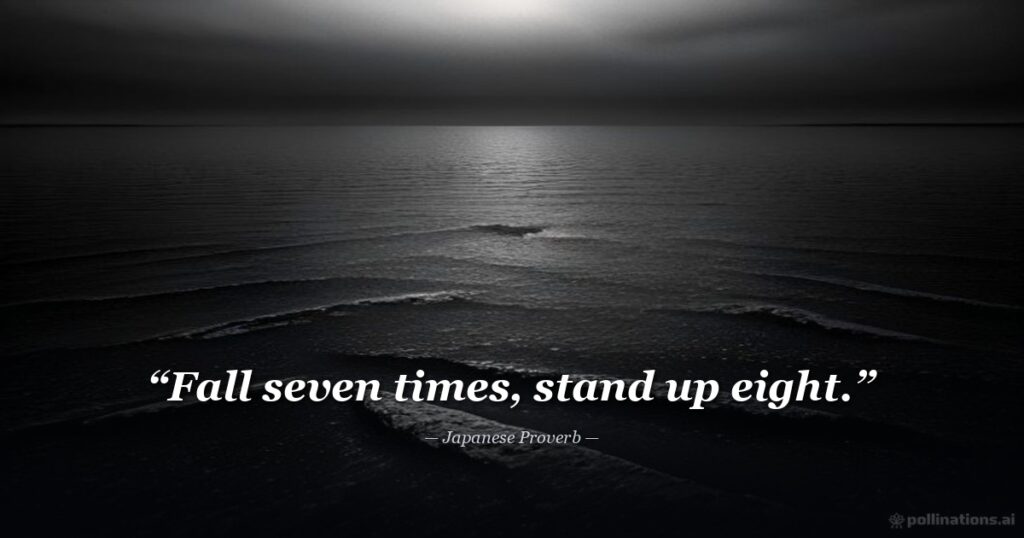
“Fall seven times, stand up eight.”
— Japanese Proverb
The Deeper Meaning: This ancient proverb strips away romanticized notions of instantaneous victory, anchoring triumph entirely in the sheer volume of repeated attempts. It reframes failure as a numerical loop rather than a permanent ceiling.
How to Apply It: The next time a project collapses, write the current count of your attempts on a piece of sticky note. Treat the next try simply as the required next number in your sequence.
“Failure is simply the opportunity to begin again, this time more intelligently.”
— Henry Ford
The Deeper Meaning: Ford rejects the idea that wasted effort is truly lost. Instead, every collapsed venture leaves behind refined expertise that makes subsequent iterations exponentially sharper.
How to Apply It: Conduct a rapid post-mortem after a misstep. Identify one single concrete variable you will alter in your next attempt based purely on this failed trial.
- “Ever tried. Ever failed. No matter. Try again. Fail again. Fail better.” — Samuel Beckett
- “The bamboo that bends is stronger than the oak that resists.” — Japanese Proverb
- “Fall down seven times, get up eight.” — Chinese Proverb
- “Fall down, stand up, breathe.” — Zen Proverb
- “Out of difficulties grow miracles.” — Jean de La Bruyere
- “The brick walls are there for a reason. They let us prove how badly we want things.” — Randy Pausch
- “Turn your wounds into wisdom.” — Oprah Winfrey
- “Pain is inevitable. Suffering is optional.” — Buddha
- “Act as if what you do makes a difference. It does.” — William James चिह्न
- “Courage is resistance to fear, mastery of fear, not absence of fear.” — Mark Twain
- “He who has a why to live can bear almost any how.” — Friedrich Nietzsche
Timeless Philosophical & Stoic Wisdom
Classical philosophy views adversity as the ultimate test of human virtue. Ancient thinkers did not pray for frictionless lives; instead, they trained their minds to welcome trials as the sole mechanism for cultivating courage, wisdom, and temperance. By stepping into the lineage of Stoicism, we realize that our external circumstances matter far less than our internal judgments. When failure strikes, the Stoic mind looks inward, identifying precisely what remains within personal control while releasing emotional attachment to what has already broken.
“The impediment to action advances action. What stands in the way becomes the way.”
— Marcus Aurelius
The Deeper Meaning: The Roman Emperor reframes every obstacle as the exact raw material needed for progress. The obstruction is not blocking the path; it has literally become the path itself.
How to Apply It: When an unexpected barrier halts your daily workflow, pause and ask aloud: “How can I use this exact inconvenience to my advantage right now?”
“Difficulties strengthen the mind, as labor does the body.”
— Seneca
The Deeper Meaning: Seneca draws a direct parallel between physical exercise and mental hardship. Without resistance, muscle atrophy occurs; without psychological strain, character weakens.
How to Apply It: Reframe a stressful professional demand not as a punishment, but as heavy lifting designed to build your psychological endurance for future challenges.
- “Don’t judge each day by the harvest you reap but by the seeds that you plant.” — Robert Louis Stevenson
- “Man is not worried by real problems so much by his imagined apprehensions about real problems.” — Epictetus
- “He who is brave is free.” — Seneca
- “We suffer more often in imagination than in reality.” — Seneca
- “Begin at once to live, and count each separate day as a separate life.” — Seneca
- “You have power over your mind – not outside events. Realize this, and you will find strength.” — Marcus Aurelius
- “Luck is what happens when preparation meets opportunity.” — Seneca
- “To be even-minded is the greatest virtue.” — Heraclitus
- “Silence is a fence around wisdom.” — German Proverb
- “The soul becomes dyed with the color of its thoughts.” — Marcus Aurelius
- “Accept the things to which fate binds you, and love the people with whom fate brings you together.” — Marcus Aurelius
Quotes for Overcoming Difficult Moments & Adversity
Life delivers unexpected tremors that shatter our carefully curated plans, testing the limits of our emotional endurance. During these dark valleys, finding the energy to take a single step forward feels monumental. Quotes centered on overcoming adversity serve as lanterns in the dark, reminding us that suffering is a universal human thread. They validate our pain while gently pulling our focus back toward the horizon, proving that even the most desolate seasons eventually yield to new growth.
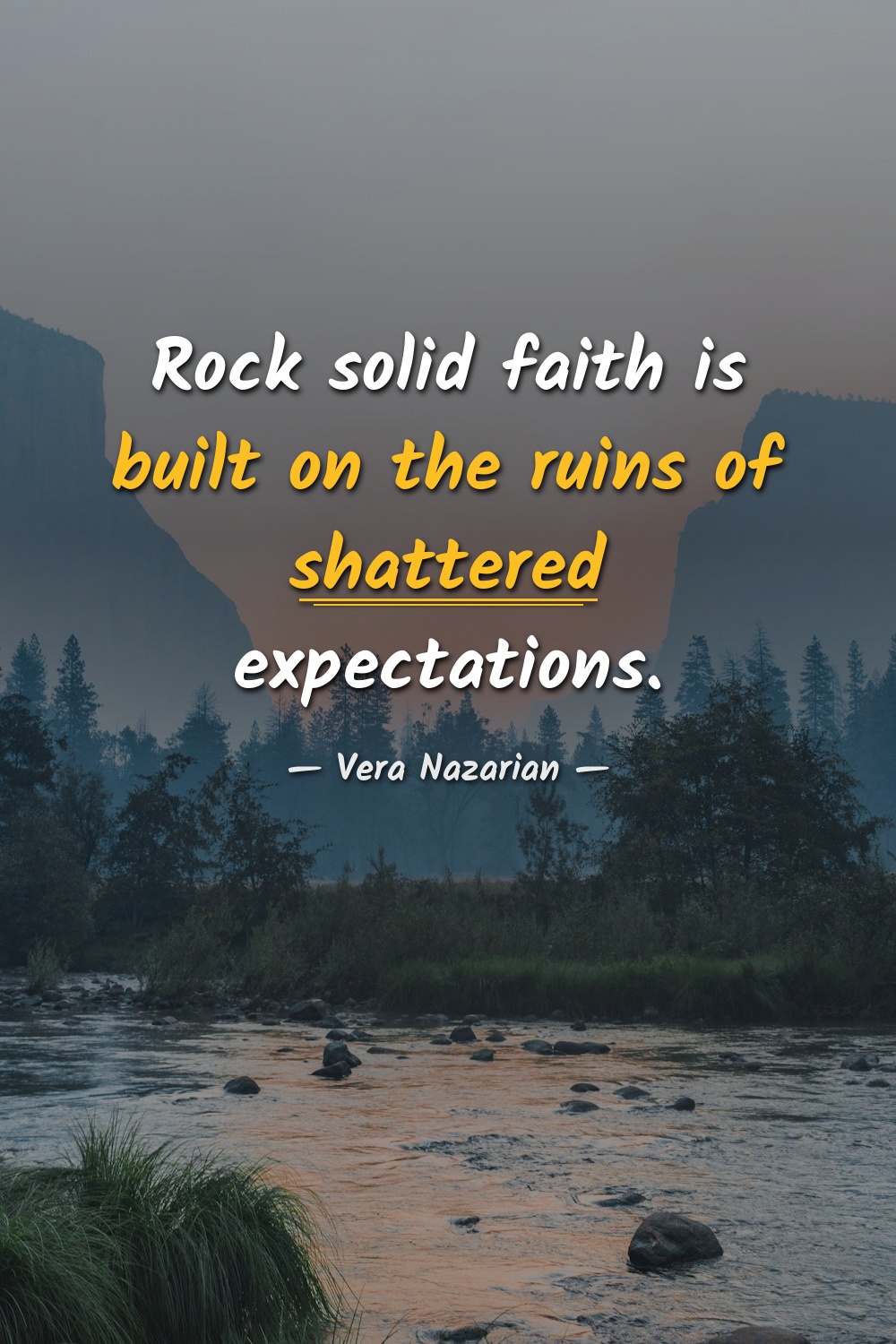
“Rock solid faith is built on the ruins of shattered expectations.”
— Vera Nazarian
The Deeper Meaning: True resilience is forged only when comfortable illusions are permanently stripped away, forcing individuals to build a more authentic, unshakeable foundation from the debris.
How to Apply It: When a major plan falls through, allow yourself twenty minutes to grieve the loss, then list three hidden advantages this unexpected blank slate provides.
“A smooth sea never made a skilled sailor.”
— Franklin D. Roosevelt
The Deeper Meaning: Competence and ease are mutually exclusive forces. Without turbulent storms and high-stakes pressure, true capability remains entirely dormant.
How to Apply It: Audit your current responsibilities. If everything feels comfortable, voluntarily step into a slightly more challenging project to keep your skills sharp.
- “Although the world is full of suffering, it is full also of the overcoming of it.” — Helen Keller
- “It does not matter how slowly you go as long as you do not stop.” — Confucius
- “You may encounter many defeats, but you must not be defeated.” — Maya Angelou
- “In the depth of winter, I finally learned that within me there lay an invincible summer.” — Albert Camus
- “When everything seems to be going against you, remember that the airplane takes off against the wind, not with it.” — Henry Ford
- “Kites rise highest against the wind – not with it.” — Winston Churchill
- “Courage doesn’t always roar. Sometimes courage is the quiet voice at the end of the day saying, ‘I will try again tomorrow.’” — Mary Anne Radmacher
- “Trouble is only opportunity in work clothes.” — Henry J. Kaiser
- “Hard times create strong men, strong men create good times.” — G. Michael Hopf
- “The gem cannot be polished without friction, nor man perfected without trials.” — Chinese Proverb
- “Character cannot be developed in ease and quiet. Only through experience of trial and suffering can the soul be strengthened.” — Helen Keller
Chapter 4: Modern Perspectives & Psychological Insights
Contemporary psychology views resilience not as a rigid, fixed genetic trait, but as a dynamic, malleable skill set that can be cultivated intentionally over time. Modern thought leaders, neuroscientists, and innovators emphasize adaptability, emotional regulation, and neuroplasticity. When we fail, our neural pathways register threat and rejection; psychological insights teach us how to soothe our biology, intercept destructive thought loops, and engineer a comeback strategy rooted in modern behavioral science.
“It is impossible to live without failing at something, unless you live so cautiously that you might as well not have lived at all — in which case, you fail by default.”
— J.K. Rowling
The Deeper Meaning: Avoiding failure requires shrinking your life to a risk-free minimum. True engagement with the world guarantees frequent stumbles, making failure a badge of a life fully experienced.
How to Apply It: Review your current goals. If you have not failed at least once this month, your targets are likely too conservative and safe.
“I have not failed. I’ve just found 10,000 ways that won’t work.”
— Thomas Edison
The Deeper Meaning: Edison completely redefines the vocabulary of trial and error. Every dead end is categorized as a successful elimination of variables, bringing the inventor closer to the truth.
How to Apply It: Keep a “Lessons Learned” journal. Whenever a strategy fails, document it not as a loss, but as an eliminated hypothesis in your ongoing experiment.
- “Success is not final, failure is not fatal: it is the courage to continue that counts.” — Winston S. Churchill
- “Everything you’ve ever wanted is on the other side of fear.” — George Addair
- “The only real mistake is the one from which we learn nothing.” — Henry Ford
- “Do not judge me by my success, judge me by how many times I fell down and got back up again.” — Nelson Mandela
- “Worrying does not empty tomorrow of its troubles, it empties today of its strength.” — Corrie ten Boom
- “Failure is the condiment that gives success its flavor.” — Truman Capote
- “Only those who dare to fail greatly can ever achieve greatly.” — Robert F. Kennedy
- “Pain is temporary. Quitting lasts forever.” — Lance Armstrong
- “Your time is limited, so don’t waste it living someone else’s life.” — Steve Jobs
- “Life is 10% what happens to you and 90% how you react to it.” — Charles R. Swindoll
- “Perseverance is not a long race; it is many short races one after the other.” — Walter Elliot
Chapter 5: Daily Affirmations & Mindset Shifts
Resilience is sustained not by massive, heroic bursts of effort, but by quiet, daily micro-commitments to mental clarity. Shifting your internal dialogue from self-criticism to constructive curiosity is the cornerstone of lifelong endurance. Daily affirmations act as mental hygiene, washing away the toxic residue of self-doubt accumulated throughout demanding days. By anchoring your mind in steady mantras, you condition your subconscious to default to courage rather than retreat when the unexpected occurs.
“Promise me you’ll always remember: You’re braver than you believe, and stronger than you seem, and smarter than you think.”
— A.A. Milne
The Deeper Meaning: Self-perception during stress is chronically distorted by fear. This gentle reminder cuts through internal gaslighting, reaffirming innate capacities that exist independently of circumstances.
How to Apply It: Speak this quote aloud to yourself during moments of acute imposter syndrome or professional rejection to recalibrate your self-worth.
“I can be changed by what happens to me. But I refuse to be reduced by it.”
— Maya Angelou
The Deeper Meaning: Hardship inevitably alters our perspective and leaves marks, but it holds no power to diminish our core human dignity unless we voluntarily surrender our agency.
How to Apply It: Write this phrase on your bathroom mirror as a daily reminder that every wound can be integrated into your strength rather than your defeat.
- “Yesterday I was clever, so I wanted to change the world. Today I am wise, so I am changing myself.” — Rumi
- “What we achieve inwardly will change outer reality.” — Plutarch
- “Keep your face to the sunshine and you cannot see a shadow.” — Helen Keller
- “Change your thoughts and you change your world.” — Norman Vincent Peale
- “Believe you can and you’re halfway there.” — Theodore Roosevelt
- “Your attitude, not your aptitude, will determine your altitude.” — Zig Ziglar
- “Fall in love with some activity, and do it! Nobody ever figures out what life is all about, and it doesn’t matter.” — Richard Feynman
- “Happiness is not something ready made. It comes from your own actions.” — Dalai Lama
- “In a gentle way, you can shake the world.” — Mahatma Gandhi
- “What lies behind us and what lies before us are tiny matters compared to what lies within us.” — Ralph Waldo Emerson
- “Smile in the mirror. Do that every morning and you’ll start to see a big difference in your life.” — Yoko Ono
How to Practice and Integrate These Quotes into Daily Life
Reading inspirational words provides a momentary dopamine lift, but true mental transformation requires systematic daily integration. To transform passive reading into active resilience, establish concrete rituals that anchor these philosophies into your routine. Begin your morning with mental anchoring by selecting a single flagship quote during your journal session. Write it down by hand and unpack what it means for the specific challenges on your calendar that day. This primes your reticular activating system to spot opportunities for courage rather than threats of failure.
During moments of acute professional stress or personal crisis, deploy the Pause-and-Reflect Technique. When your heart rate spikes and frustration mounts, physically step away from the task for ninety seconds. Recite a short resilience mantra from Chapter 1 or Chapter 3, and ask yourself a grounding Stoic question: “What part of this crisis is within my immediate control?” By separating your emotional reaction from objective reality, you prevent panic from dictating your next move.
Finally, close your day with evening gratitude and perspective alignment. Instead of passively scrolling through social media before sleep, review your day through the lens of growth and data collection. Ask yourself: “Where did I stumble today, and what did that failure teach me?” By reframing missteps as valuable feedback loops before you sleep, you train your subconscious mind to process adversity productively overnight, waking up lighter and infinitely more prepared for whatever tomorrow brings.
Frequently Asked Questions
Why do quotes about resilience help people overcome failure?
Quotes condense decades of profound human wisdom into concise, highly memorable packages. When individuals experience failure, their cognitive capacity narrows due to stress. Reading an authoritative, relatable quote instantly shifts perspective, interrupts panic, and provides a proven psychological framework for bouncing back.
How can I use resilience quotes effectively in my daily routine?
Instead of reading quotes passively, select one quote per week to focus on. Write it in your journal, use it as a desktop wallpaper, and apply its core lesson to a specific challenge you are facing. Active application turns passive inspiration into lasting behavioral change.
Are quotes on resilience backed by psychological science?
Yes. Cognitive reframing—the core mechanism behind many resilience quotes—is a foundational technique in cognitive behavioral therapy (CBT). Changing how you talk to yourself about failure directly alters your emotional response, stress hormone levels, and problem-solving abilities.
Closing Reflection
Failure is never the end of the narrative; it is merely the turbulent middle chapter of a much larger story of human endurance. When the weight of a setback feels unbearable, remember that every trial you currently face is actively carving out the depth, strength, and wisdom you will rely upon tomorrow. Stand back up, dust off the debris, and trust in the unyielding resilience woven deep within your human spirit.